What the foundation work covers
- Checking the concrete walls and footing and locating cracks, joints and pipe openings
- Cleaning the surface and removing loose material and oil
- Treating cracks, pipe openings and joints before waterproofing
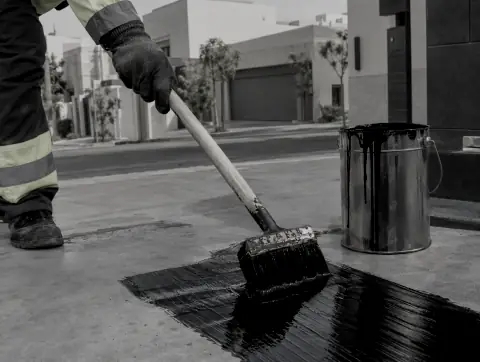
- Applying the waterproof layer in bitumen rolls or bitumen coating according to the surface
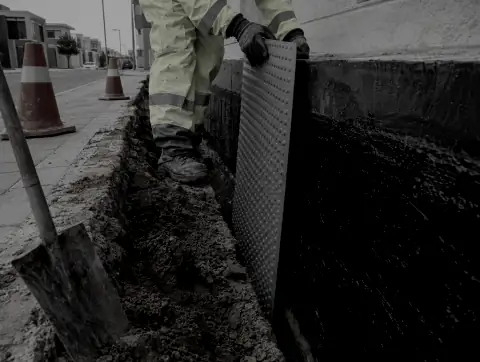
- Fixing protection boards over the waterproof layer before backfill
- Checking layer continuity at corners, edges and critical points
How foundation waterproofing goes
Send site photos
On WhatsApp: photos of the exposed walls or the indoor damp patches and the base, so we can read the situation and decide the right treatment.
Prepare the surface
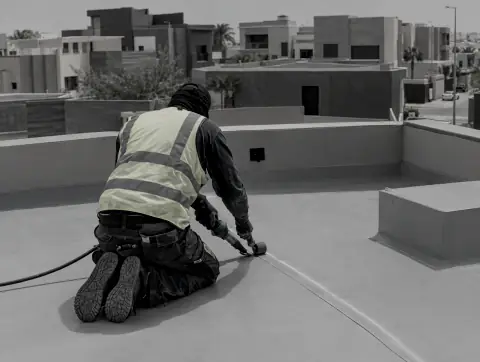
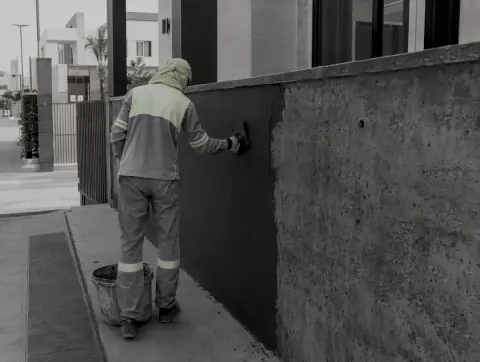
The concrete walls are cleaned of dust, oil and anything loose, and cracks, joints and pipe openings are treated before any waterproof layer, because these are where water enters first.
Apply the waterproof layer
Bitumen rolls, a bitumen coating or the appropriate membrane are applied to the wall and the footing in continuous layers that rise above the backfill level and extend to the base of the foundation, according to what the surface calls for.
Protection boards then backfill
Protection boards are fixed over the waterproof layer to guard it from soil friction and backfill damage, then the site is backfilled once the layer has dried and set.
Why Abraj Al Azl?
The structure kept from moisture and saltsConstant moisture attacks the reinforcement and weakens the concrete over time, and the waterproof layer cuts that off from the start.
No excavation after the buildProper waterproofing during construction avoids costly later excavation to reach the wall from outside.
We reply 5 AM to 10 PMSaturday to Thursday, and Friday on its own hours.
Talk to us directlyCall or WhatsApp on the same number.
Some of our work

















What our customers said
اتعاملت معاهم في العوازل عند كفيلي شغل يبيض الوجه انص التعامل معهم
ماشاء الله تبارك الرحمن عزل اسطح ممتاز
ماشاء الله عملهم للعزل والتسريبات ممتاز وخبره ودقه في العمل انصح بالتعامل معهم
Real Google reviews, shown exactly as their authors wrote them.
Questions about foundation waterproofing
What is the difference between waterproofing foundations in a new build and in an existing building?
In a new build the walls are exposed, so the waterproof layer goes straight onto clean concrete and is protected with boards before backfill. In an existing building the ground has to be excavated to reach the wall from outside, or an internal treatment is used depending on the situation. Send site photos on WhatsApp and we will advise.
What materials are used in foundation waterproofing?
Common materials include torch-on or self-adhesive bitumen rolls, cold bitumen coating, and composite membranes, together with protection boards that shield the layer from soil pressure and backfill. The material choice depends on the wall, the soil conditions and the depth of the foundation.
Why do cracks and joints need special treatment before waterproofing?
Cracks, joints and pipe openings are the weakest points in a concrete wall against water. If the waterproof layer is applied over them without treatment it will crack in time and let water through. They are filled and treated first so the waterproof layer has a sound base.
What do the protection boards do over the waterproof layer?
Backfill and soil movement rub against the waterproof layer and can tear it. Protection boards form a hard shield that takes that friction instead of the layer, keeping it sound and effective for longer. Fitting them is part of the correct sequence for this type of waterproofing.
What decides the cost of foundation waterproofing?
The area of wall to be treated, the depth of the foundation, the condition of the concrete and the number of cracks, whether excavation is needed to reach the wall, and the material that suits the site. Send photos and rough dimensions on WhatsApp so we can work out the treatment and the cost.
Is the waterproof layer affected by salty soil?
Soil contains salts and sulphates that attack unprotected concrete. The waterproof layer is therefore chosen to resist those salts, and protection boards are added to stop the soil reaching the layer directly. We confirm the right materials once we know the site conditions.
Areas for foundation waterproofing
Choose your area to open the page for this service there.
More in Bitumen & membrane insulation