Epoxy waterproofing in Second Industrial Area
We apply epoxy waterproofing to floors, tanks and warehouses in the Second Industrial Area of the Eastern Province. Send photos of the space and surface by call or WhatsApp so we can define the requirement precisely.
The Second Industrial Area holds buildings, warehouses and facilities with heavy use, so their floors face vehicle traffic and spills. Continuous epoxy gives a resistant, easy-to-clean surface, but it needs careful concrete preparation and crack repair first. How each facility is used determines the layer thickness and resin type, so we rely on the photos to decide.
- The Second Industrial Area is an industrial zone in the Eastern Province, near the First and Third Industrial Areas.
- A floor carrying vehicle traffic needs a thicker, tougher resin than an office floor.
The epoxy waterproofing work in Second Industrial Area
- Emptying the tank or pool and waiting for the surface to dry fully
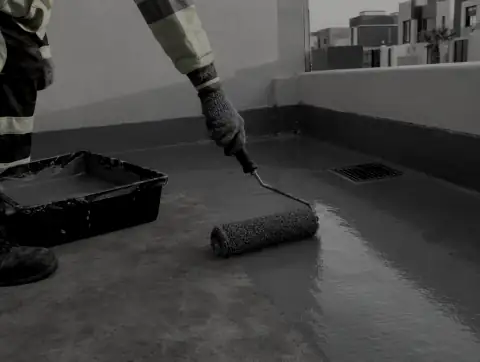
- Applying epoxy layers with particular care at corners, joints and drain outlets
- Inspecting the internal surface and locating leak points and cracks
- Cleaning the surface, removing old coatings and roughening it
From first contact to the finished job in Second Industrial Area
Send photos of the surface
On WhatsApp: photos inside the tank, the pool or on the floor, showing the cracks, joints and anywhere the leak shows, so we can decide the right treatment.
Dry and prepare the surface
The tank or pool is emptied completely and the surface is left to dry, because epoxy does not bond to damp concrete. The surface is cleaned of dirt and old coatings, then roughened or treated to open the concrete pores.
Treat cracks and joints
Hairline cracks are opened slightly and cleaned, then filled with a suitable material before the resin goes on, because the layer alone does not bridge moving or wide cracks.
Apply the resin layers and let them cure
The two epoxy parts are mixed and successive layers are applied, each left to cure before the next, with particular care at corners, joints and drain outlets.
Why Abraj Al Azl?
A hard surface that resists standing waterOnce cured, the resin is hard and resists standing water and cleaning agents, making it suitable for tanks, basins and wet floors.
We serve Second Industrial Area and around itIncluding First Industrial Area, Third Industrial Area and Industrial Area, as part of our work across the Eastern Province.
Second Industrial Area is in our service areaWe work there and across the Eastern Province, from our base in Al Uwaymiriyah, Hofuf.
Talk to us directlyCall or WhatsApp on the same number.
Some of our work

















What our customers said
اتعاملت معاهم في العوازل عند كفيلي شغل يبيض الوجه انص التعامل معهم
ماشاء الله عملهم للعزل والتسريبات ممتاز وخبره ودقه في العمل انصح بالتعامل معهم
ماشاء الله تبارك الرحمن عزل اسطح ممتاز
Real Google reviews, shown exactly as their authors wrote them.
Before you book epoxy waterproofing in Second Industrial Area
Can epoxy withstand vehicle traffic in industrial warehouses?
It can, if the thickness and resin type are matched to the use. We confirm this after reviewing the floor and traffic pattern through the photos.
Does an industrial floor need drying before application?
Yes, moisture in the concrete stops the resin bonding properly. We will tell you the surface condition from the photos before preparation begins.
What decides the cost of epoxy waterproofing?
The area to be treated, its condition in terms of cracks, dirt and old coatings, how easily the site can be reached, and whether cracks need work before the resin goes on. Send photos with rough dimensions on WhatsApp and we will explain what the treatment covers.
Do you cover Second Industrial Area?
Yes. We serve Second Industrial Area and nearby areas such as First Industrial Area, Third Industrial Area and Industrial Area, from our base in Al Uwaymiriyah, Hofuf. Start with a call or a WhatsApp message.
Why must the surface be completely dry before epoxy is applied?
Epoxy is a chemical resin that needs to react with the concrete, not with water. Moisture in the concrete prevents full adhesion and can cause the layer to blister or separate later. That is why tanks are emptied and the surface is left to dry before work begins.
Is epoxy suitable for waterproofing external roof surfaces?
Epoxy is mainly suited to internal surfaces. Outdoors the layer is exposed to ultraviolet light, which causes yellowing and gradual loss of its properties. On open external surfaces, other materials such as bitumen or liquid membranes are usually more suitable. Photos help us advise which is right for your surface.
The same service in nearby areas
We also work near Second Industrial Area, in First Industrial Area, Third Industrial Area and Industrial Area.
More services in Second Industrial Area