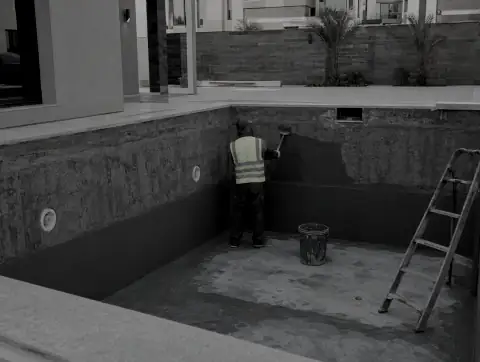
Cementitious pool waterproofing in Western Arabian Gulf
Cementitious pool waterproofing in the Western Arabian Gulf district begins with WhatsApp photos of the pool interior and exterior. The area has multi-storey residential buildings and private homes with private or shared pools, all needing protection from water leaks.
Large residential building pools in this area may be old or new, and constant exposure to water and salt from the coastal air stresses the concrete rapidly. Cracks start small at corners and joints between pool walls, and very high humidity speeds decay. Flexible cementitious coating bonds to the concrete, fills fine cracks and protects the underlying layer from corrosion. But the coating's success depends on surface cleanliness and the integrity of the base structure, which the photos will reveal first.
- The Western Arabian Gulf district is a coastal area in the Eastern Province, near Al Muruj and Al Faisaliyah.
- Pools near the coast accumulate salt and moisture, so cementitious coating must withstand these harsh conditions continuously.
The cementitious pool waterproofing work in Western Arabian Gulf
- Closing return pipe openings and drain outlets before the coating goes on
- Treating hairline cracks and the wall-to-floor junction
- Wet curing after application so the coating sets correctly
- Applying the flexible cementitious layer over the whole shell
How we carry out cementitious pool waterproofing in Western Arabian Gulf
Send photos of the pool
On WhatsApp: photos of the walls, the floor, any cracks, the pipe openings and the drains, so we can read the concrete and decide the right treatment.
Prepare the concrete surface
The surface is cleaned of dust, oils and any adhesive residue, then hairline cracks, wall-to-floor junctions and pipe openings are treated before any layer goes on.
Apply the cementitious coating
The flexible cementitious coating is applied over the whole shell, walls and floor, turning up at corners and edges, and tightened around every pipe opening and drain, depending on the surface.
Wet curing and drying
The layer is kept moist after application so it cures correctly, then left to dry before tile adhesive goes on, because drying too fast weakens its bond to the concrete.
Why Abraj Al Azl?
Bonds to concrete and to the tilesThe cementitious layer accepts a bond from both sides: concrete below and tile adhesive above, so the coating does not delaminate and the tiles do not loosen over time.
Your request from Western Arabian Gulf comes to usCall or WhatsApp on one number, and we answer you ourselves.
Western Arabian Gulf is in our service areaWe work there and across the Eastern Province, from our base in Al Uwaymiriyah, Hofuf.
We reply 5 AM to 10 PMSaturday to Thursday, and Friday on its own hours.
Some of our work

















What our customers said
اتعاملت معاهم في العوازل عند كفيلي شغل يبيض الوجه انص التعامل معهم
ماشاء الله عملهم للعزل والتسريبات ممتاز وخبره ودقه في العمل انصح بالتعامل معهم موفقين يارب
أفضل شركة عزل اسطح الفوم وخزانات المياه
Real Google reviews, shown exactly as their authors wrote them.
Your questions on cementitious pool waterproofing in Western Arabian Gulf
Does coastal humidity cause rapid pool deterioration?
Yes, high humidity and airborne salt speed cracking and corrosion in concrete. Cementitious coating reduces these effects but the surface must be carefully prepared before application.
Can shared pools in apartment buildings be waterproofed while the building is occupied?
Yes, but it requires coordination with building management to shut down the pool temporarily while the surface is cleaned and the coating applied. Send photos of the pool and tell us the operating schedule so we can agree on timing.
Why is the cementitious coating kept moist after it is applied?
Cement sets through a chemical reaction that needs water. If the surface dries too fast because of heat or sun, the reaction weakens and hairline cracks open in the coating itself. Keeping it moist gives the layer time to cure properly before it is left to dry and receive the tiles.
How do I know if the concrete is ready for the cementitious coating?
The surface should be clean and free of oils, dust and old adhesive residue, and any large cracks should have been treated first. You do not need to judge this yourself: send photos of the concrete on WhatsApp and we will tell you whether it needs more preparation before we start.
Do you offer cementitious pool waterproofing in Western Arabian Gulf?
Yes. Western Arabian Gulf is within our service area in the Eastern Province, and we also work in Eastern Arabian Gulf, Al Muruj (near Al Khafji) and Al Faisaliyah (near Al Khafji). Call us or send photos of the spot on WhatsApp.
Does cementitious waterproofing work for both in-ground and above-ground pools?
Yes. The cementitious layer goes onto concrete regardless of where the pool sits. The difference is the soil and groundwater pressure on a buried shell, which affects how cracks and joints are treated. Photos and the site details help us work out what is needed.
Areas near Western Arabian Gulf
We also work near Western Arabian Gulf, in Eastern Arabian Gulf, Al Muruj (near Al Khafji) and Al Faisaliyah (near Al Khafji).
More services in Western Arabian Gulf