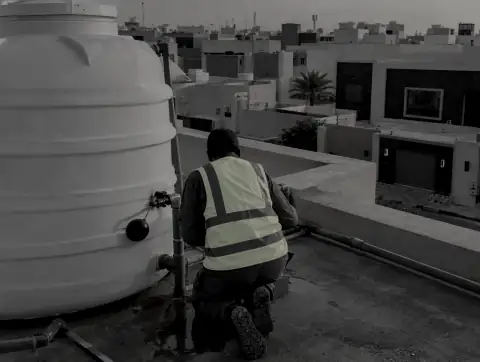
Overhead tank leak detection in Hazm
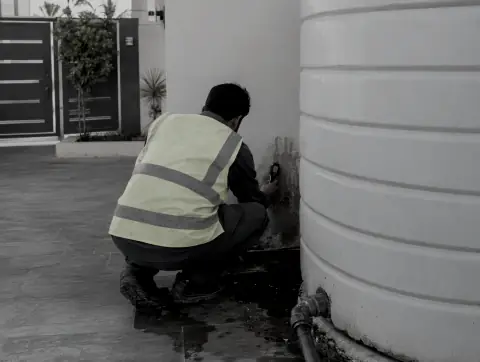
Overhead tank leak detection in Hazm starts with photos of the tank and surroundings sent by call or WhatsApp. The district has old and new villas and blocks, with tanks prone to leaks from the base, joints and cracks in the body. We pinpoint the leak source to choose the right repair method.
Hazm has a mix of old and newer buildings, so tanks vary in size, condition and material. An exposed roof tank is subject to all-day sun and dry winds, expanding and contracting, which stress joints. Leaks may be obvious or very slow depending on the crack or break size. Photos from above and below help us know whether the leak is from outside or inside.
- Hazm is a district in the Eastern Province, near Safwa, Al Urubah and Al Marwah, with varied villas and residential blocks.
- Pipe joints in tanks exposed to heat and dryness corrode faster, making them a common weak point.
What we do for you in Hazm
- Level testing with the tank isolated from the distribution line
- Verifying the float valve and the overflow outlet
- Checking inlet and outlet pipe joints inside and outside
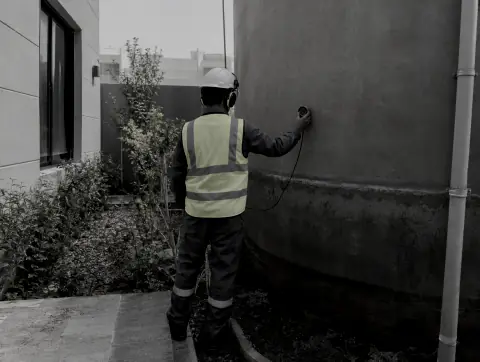
- Checking the tank body for hairline cracks and blisters
This is how we work in Hazm
Send photos of the tank and the stains
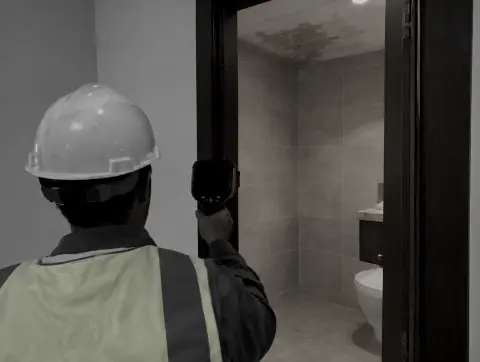
On WhatsApp: photos of the tank from outside, its base, the pipe connections and the stain on the ceiling or wall, so we read the situation before anything else.
Isolate the pump and read the level
The tank is isolated from the distribution line and the level is read at two intervals without any draw, to confirm water is leaving and to read how much.
Check the body, joints and overflow
The tank body is checked for cracks and blisters, every pipe joint is checked inside and out, and the overflow outlet is checked to confirm it closes at the right level and is not weeping.
Pin the source and direct the repair
After inspection the source is pinned: a crack in the body, an open joint, a loose pipe connection or a faulty overflow, and the right repair is directed to that point.
Why Abraj Al Azl?
No wasted repairs on the wrong surfacePrecise detection sends the repair to the real source, so money is not spent re-waterproofing a roof that was never the cause.
Your request from Hazm comes to usCall or WhatsApp on one number, and we answer you ourselves.
Overhead tank leak detection in HazmWe choose the method and the materials once we know the condition of the spot.
We reply 5 AM to 10 PMSaturday to Thursday, and Friday on its own hours.
Some of our work

















What our customers said
أفضل شركة عزل اسطح الفوم وخزانات المياه
ماشاء الله عملهم للعزل والتسريبات ممتاز وخبره ودقه في العمل انصح بالتعامل معهم
ماشاء الله تبارك الرحمن عزل اسطح ممتاز
Real Google reviews, shown exactly as their authors wrote them.
Common questions on overhead tank leak detection in Hazm
What is the difference between a leak from the base and one from the body?
A base leak is where the tank sits on the roof, usually from cracks in the joint between tank and roof. A body leak is from cracks in the tank walls. The location determines the repair method, and photos make it clear.
Does a slow leak cause real damage to the building?
Yes, even a slow leak causes continuous dampness in the ceilings and walls below the tank, which can lead to cracking plaster, paint and mould over time. Slowness means the problem may go unnoticed for weeks or months. Early detection stops damage before it worsens.
Where does a roof tank usually leak?
The most common points are the inlet and outlet pipe connections where they pass through the tank wall, the base where the tank body meets the concrete stand, the overflow outlet if its float valve is neglected, and hairline cracks in the tank body from years of thermal movement.
What should I send you from Hazm?
Send clear photos of the spot and a short description of the problem on WhatsApp, mention that you are in Hazm, and we will work out the next step with you.
How do I tell a tank leak from a roof leak?
If the stain is directly under the tank or near pipe connections, and the level drops without any draw, the tank is the more likely source. If the stain is far from the tank and appears after rain, the roof is more likely. Detection settles it precisely because water travels through the concrete before it shows.
Does the tank need to be emptied before detection?
A full empty is not needed for detection. Isolating the tank from the distribution line and reading the level at two intervals is enough to start, and the body and joints are checked from outside. Emptying is needed if inspection from inside or repair after detection requires it.
Areas near Hazm
If the site is outside Hazm, the same service is available in Safwa, Al Urubah (near Safwa) and Al Marwah.
More services in Hazm