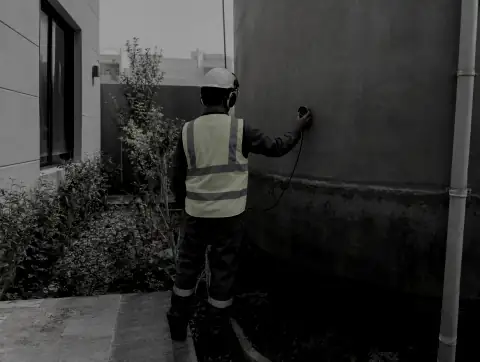
Ground tank leak detection in Khawr ah Dhi'abah
Ground tank leak detection in Khawr ah Dhi'abah starts with photos of the tank, the pipe runs and any damp on the ground, sent by call or WhatsApp. Homes and farm buildings here are spread apart, so the tank and its pipes can cover a wide stretch of land.
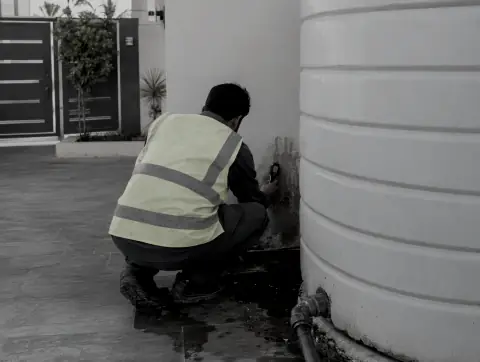
Khawr ah Dhi'abah is a village of scattered houses and farm buildings, with some plots used for farming. The ground tank may stand beside a shed or a house wall, and its supply pipes can run a long way across open ground. A leak along that route may appear as soft ground or a wet patch far from the tank itself. We check the tank walls, the floor and the pipe connections, then follow the line to the point where water leaves. Photos of the route help us see where that check should begin.
- Khawr ah Dhi'abah is a village in the Eastern Province, close to AL Jabiriyah, Qusayba' and Ash Shuhayla'.
- Pipes run over open ground can hide a leak, since the water may surface well away from the line.
The ground tank leak detection work in Khawr ah Dhi'abah
- Identifying the leak source and presenting the suggested repair
- Checking the inlet, outlet and overflow pipe connections
- Telling outward water loss from inward groundwater entry
- Inspecting where pipes pass through the tank walls
The stages of the work in Khawr ah Dhi'abah
Send a description and photos
Call us or send on WhatsApp: photos of the tank if it is accessible, and a description of what you are seeing, such as the level drop or the damp ground, so we can plan where to start.
Level test with supply shut off
The water supply is shut off and the level is recorded, then read again after a set period. This confirms whether there is real loss and separates it from normal use or groundwater entering from outside.
Check the connections and pipes
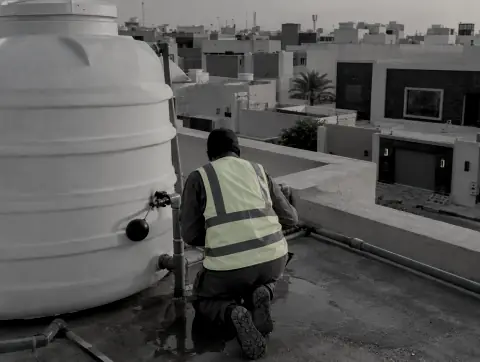
The inlet, outlet and overflow connections and the points where pipes pass through the wall are checked, as these are the spots most likely to leak in a ground tank, under movement and pressure.
Inspect the walls and floor inside
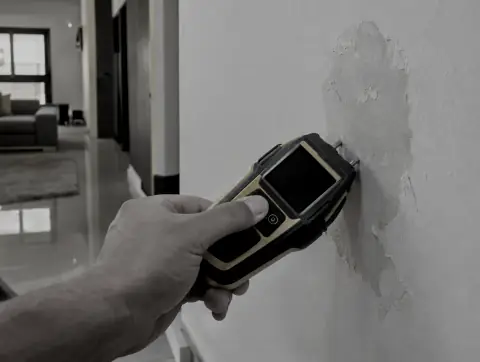
The interior is inspected for cracks, hairline cracks and seeping spots. Each point is assessed by its size and position to decide whether it is a source of loss or an entry point for outside water.
Why Abraj Al Azl?
Finding the source prevents guesswork repairsTreating the wrong spot costs time and money without stopping the loss. Accurate detection points the repair at the right place.
Khawr ah Dhi'abah is in our service areaWe work there and across the Eastern Province, from our base in Al Uwaymiriyah, Hofuf.
Ground tank leak detection in Khawr ah Dhi'abahWe choose the method and the materials once we know the condition of the spot.
We reply 5 AM to 10 PMSaturday to Thursday, and Friday on its own hours.
Some of our work

















What our customers said
ماشاء الله عملهم للعزل والتسريبات ممتاز وخبره ودقه في العمل انصح بالتعامل معهم موفقين يارب
أفضل شركة عزل اسطح الفوم وخزانات المياه
ماشاء الله تبارك الرحمن عزل اسطح ممتاز
Real Google reviews, shown exactly as their authors wrote them.
Your questions on ground tank leak detection in Khawr ah Dhi'abah
Can a leak be traced along a long pipe run?
Often yes, by checking the pipe at intervals from the tank outward and noting where the ground is wet or soft. Whether the source sits in the tank, the wall or a joint is decided after reviewing the photos and the check.
Do you need the exact pipe route before starting?
No, you do not need to know the exact route. Send photos of the tank and any visible pipe, and mark roughly where the wet or soft ground appears. That is enough to decide where the check begins.
Is leak detection different for a buried tank and an above-ground tank?
A buried tank cannot have its outer walls checked directly, so detection relies more on the level test and an internal check of the walls and connections. An above-ground ground tank allows the outer wall to be read for damp marks. Tell us which type you have when you get in touch.
Is Khawr ah Dhi'abah within your service area?
Yes, Khawr ah Dhi'abah is one of the areas we work in, as are AL Jabiriyah, Qusayba' and Ash Shuhayla'. To start, call us or message us on WhatsApp.
How does a fully buried tank differ from a partly exposed ground tank when it comes to detection?
A fully buried tank cannot have its outer walls checked directly, so detection rests on the level test and an internal check of the walls and connections. A partly exposed tank lets the outer wall be read for damp marks, which narrows the search. Tell us the type and burial depth when you get in touch.
Can the leak be repaired straight after the source is found?
In many cases the right treatment can be identified straight after detection, whether that is crack injection, joint treatment or internal wall waterproofing. It depends on what the inspection finds and how wide the affected area is. We present the suggested repair once the detection stage is done.
The same service in nearby areas
We also offer ground tank leak detection in AL Jabiriyah, Qusayba' and Ash Shuhayla', among the closest areas to Khawr ah Dhi'abah.
More services in Khawr ah Dhi'abah