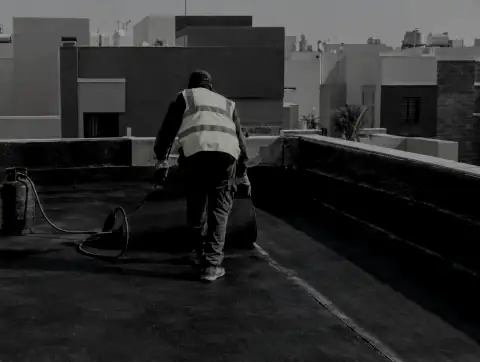
Bitumen roof waterproofing in Gharb An Nabiyah
Bitumen roof waterproofing in West An Nabiyah starts with a photo of the roof, sent by call or WhatsApp. The district lies near An Nabiyah, Ar Rimal and Al Jish, and is largely made up of houses with exposed flat roofs.
Houses in West An Nabiyah look older in some streets and newer in others, and their flat roofs stay exposed to the sun for most of the day. The old bitumen layer often breaks around openings, pipe entries outside the house and at the edges that move with expansion. What each home needs differs, so every case is assessed on its own.
- West An Nabiyah is a district in Dammam in the Eastern Province, close to An Nabiyah, Ar Rimal and Al Jish.
- Exposed roofs expand and contract with heat, so the layer usually cracks first at edges and openings.
What the service covers in Gharb An Nabiyah
- Closing the layer around AC bases, the tank stand and drain openings
- Inspecting the roof and locating cracks and leak points
- Adding the protective layer over the bitumen once it has cured
- Laying bitumen rolls in overlapping strips and bonding them
The steps of bitumen roof waterproofing in Gharb An Nabiyah
Send photos of the roof
On WhatsApp: photos of the roof surface, the parapet, the AC bases, the tank stand and the drain outlets, so we can read the condition and decide the right treatment.
Clean the surface and treat cracks
The surface is cleaned of dust and debris, and hairline cracks, joints and wider cracks are treated before any roll goes down, because a membrane cannot seal over a crumbling surface.
Lay the bitumen rolls
The rolls are laid in overlapping strips and bonded by heat or adhesive depending on the type, then turned up at the parapet and closed tightly around AC bases, the tank stand and drain openings to form one continuous layer.
Protect the membrane on top
A protective layer is added over the rolls depending on the surface and how it is used, to shield the bitumen from direct sun and from wear, and to extend the life of the membrane.
Why Abraj Al Azl?
One continuous layer, no gapsOverlapping rolls and sealed edges stop water from finding a path under the membrane at any join.
We serve Gharb An Nabiyah and around itIncluding An Nabiyah, Ar Rimal and Al Jish (near Mallahah), as part of our work across the Eastern Province.
Start from Gharb An Nabiyah with one messageSend us photos of the spot on WhatsApp and we will work out the next step with you.
Talk to us directlyCall or WhatsApp on the same number.
Some of our work

















What our customers said
ماشاء الله تبارك الرحمن عزل اسطح ممتاز
اتعاملت معاهم في العوازل عند كفيلي شغل يبيض الوجه انص التعامل معهم
أفضل شركة عزل اسطح الفوم وخزانات المياه
Real Google reviews, shown exactly as their authors wrote them.
Before you book bitumen roof waterproofing in Gharb An Nabiyah
How do I know my roof in West An Nabiyah needs waterproofing?
Signs include stains on the ceiling below, peeling of the layer or cracks around openings. Send photos of the roof and we will tell you whether it needs action now or monitoring.
Does the method differ between older and newer streets in West An Nabiyah?
Preparation details can differ, as older concrete usually needs more repair before the layer goes on. The photos establish the actual condition of each roof.
What is the difference between bitumen rolls and a liquid waterproof coating on a roof?
Bitumen rolls are a solid continuous layer bonded by heat or adhesive, thick and resistant to tearing. A liquid coating is poured or brushed on and sets in place. The choice depends on the roof surface, how level it is and how the water drains. Photos help us decide which fits your roof.
Is Gharb An Nabiyah within your service area?
Yes, Gharb An Nabiyah is one of the areas we work in, as are An Nabiyah, Ar Rimal and Al Jish (near Mallahah). To start, call us or message us on WhatsApp.
Why is the bitumen turned up at the parapet?
Water does not only get in from the middle of the roof. It gets in where the membrane meets the parapet. Turning the roll up at the wall closes that joint and stops water from entering at the edge and travelling under the membrane.
What should I expect once the work is done?
The roof will be covered with a continuous bitumen membrane, turned up at the edges and around all projecting elements, with a protective layer on top. The membrane must be left to cure fully before the roof is used again, and we tell you when it is ready when the work is agreed.
The same service in nearby areas
Nearby areas we also cover: An Nabiyah, Ar Rimal and Al Jish (near Mallahah).
More services in Gharb An Nabiyah