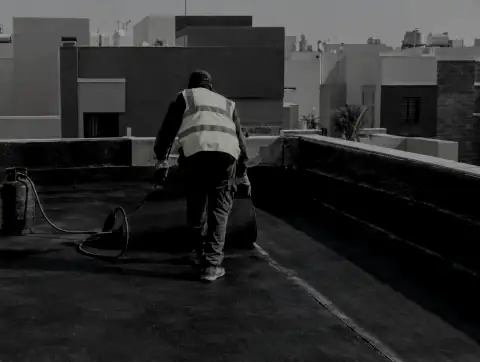
Bitumen roof waterproofing in Al Batha
Bitumen roof waterproofing in Al Batha begins with roof photos sent via WhatsApp or call. The village comprises scattered houses and villas, whose flat roofs endure harsh heat and occasional moisture from rare rainfall.
Al Batha has houses and villas with flat roofs facing direct heat and continuous dryness. Older roofs often need cracks repaired and sealing around openings, while newer roofs may only need the outer layer renewed. Distant coastal moisture can penetrate fine cracks and weaken the base. Photos determine whether full waterproofing or renewal alone is needed.
- Al Batha is a village in the Eastern Province, near As Sikak, Salwa and Mehdar, with scattered houses and villas.
- A flat roof in a village develops cracks from bitumen expanding in the day and contracting at night.
What the service covers in Al Batha
- Turning the layer up at the parapet and sealing all edges
- Cleaning the surface and treating hairline cracks and joints
- Adding the protective layer over the bitumen once it has cured
- Closing the layer around AC bases, the tank stand and drain openings
From first contact to the finished job in Al Batha
Send photos of the roof
On WhatsApp: photos of the roof surface, the parapet, the AC bases, the tank stand and the drain outlets, so we can read the condition and decide the right treatment.
Clean the surface and treat cracks
The surface is cleaned of dust and debris, and hairline cracks, joints and wider cracks are treated before any roll goes down, because a membrane cannot seal over a crumbling surface.
Lay the bitumen rolls
The rolls are laid in overlapping strips and bonded by heat or adhesive depending on the type, then turned up at the parapet and closed tightly around AC bases, the tank stand and drain openings to form one continuous layer.
Protect the membrane on top
A protective layer is added over the rolls depending on the surface and how it is used, to shield the bitumen from direct sun and from wear, and to extend the life of the membrane.
Why Abraj Al Azl?
Protection for the reinforcementWater that reaches the reinforcement causes rust and weakens the slab. Sealing the roof early stops that path.
Start from Al Batha with one messageSend us photos of the spot on WhatsApp and we will work out the next step with you.
Al Batha is in our service areaWe work there and across the Eastern Province, from our base in Al Uwaymiriyah, Hofuf.
Talk to us directlyCall or WhatsApp on the same number.
Some of our work

















What our customers said
ماشاء الله عملهم للعزل والتسريبات ممتاز وخبره ودقه في العمل انصح بالتعامل معهم موفقين يارب
ماشاء الله تبارك الرحمن عزل اسطح ممتاز
اتعاملت معاهم في العوازل عند كفيلي شغل يبيض الوجه انص التعامل معهم
Real Google reviews, shown exactly as their authors wrote them.
Before you book bitumen roof waterproofing in Al Batha
Are hairline cracks in my roof in Al Batha dangerous?
They may look small but allow water to enter gradually, especially after rain. They must be treated before they widen. Photos show their depth and affected area.
How often should I renew roof waterproofing in Al Batha?
It depends on the current layer's age and bitumen condition. Sound bitumen may last years, but cracks and wear need prompt treatment. Photo inspection determines the state.
Do you cover Al Batha?
Yes. We serve Al Batha and nearby areas such as As Sikak, Salwa and Mehdar, from our base in Al Uwaymiriyah, Hofuf. Start with a call or a WhatsApp message.
What is the difference between bitumen rolls and a liquid waterproof coating on a roof?
Bitumen rolls are a solid continuous layer bonded by heat or adhesive, thick and resistant to tearing. A liquid coating is poured or brushed on and sets in place. The choice depends on the roof surface, how level it is and how the water drains. Photos help us decide which fits your roof.
Why is the bitumen turned up at the parapet?
Water does not only get in from the middle of the roof. It gets in where the membrane meets the parapet. Turning the roll up at the wall closes that joint and stops water from entering at the edge and travelling under the membrane.
Does the dark surface of bitumen make the rooms below hotter?
Yes, a dark surface absorbs more heat than a white reflective coating. If the main goal is cutting the heat in the rooms below, there are dedicated heat-insulation treatments. If the goal is stopping the leak, bitumen does that job, and a reflective layer can sometimes be added over it depending on the surface.
More services in Al Batha