Cementitious pool waterproofing in Umm Rubayah
In Umm Rubayah we apply a flexible cement-based coating to the walls and floor of concrete pools. We start from photos sent by call or WhatsApp, then decide the method that suits the concrete and tiles of your pool.
Umm Rubayah is a village of scattered houses and small residential clusters, with pools usually built within walls or in the yard. Leaks here tend to start at tile grout lines, around drain outlets, and in basin corners that crack over time. The photos reveal which of these is present, and the work follows from them.
- Umm Rubayah is a village in the Eastern Province, lying close to Umm al Hamam, UmmTali and Urayirah.
- A concrete basin works under water pressure from inside, so any small crack at a corner or joint shows up.
The cementitious pool waterproofing work in Umm Rubayah
- Treating hairline cracks and the wall-to-floor junction
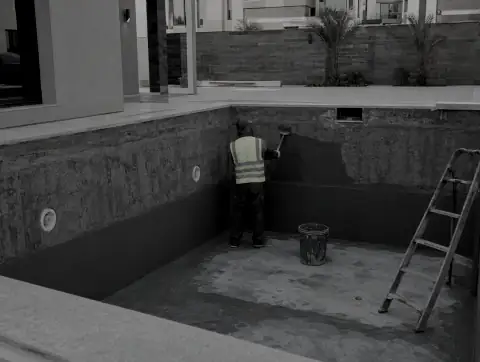
- Applying the flexible cementitious layer over the whole shell
- Wet curing after application so the coating sets correctly
- Checking the pool walls and floor and locating cracks and openings
How we carry out cementitious pool waterproofing in Umm Rubayah
Send photos of the pool
On WhatsApp: photos of the walls, the floor, any cracks, the pipe openings and the drains, so we can read the concrete and decide the right treatment.
Prepare the concrete surface
The surface is cleaned of dust, oils and any adhesive residue, then hairline cracks, wall-to-floor junctions and pipe openings are treated before any layer goes on.
Apply the cementitious coating
The flexible cementitious coating is applied over the whole shell, walls and floor, turning up at corners and edges, and tightened around every pipe opening and drain, depending on the surface.
Wet curing and drying
The layer is kept moist after application so it cures correctly, then left to dry before tile adhesive goes on, because drying too fast weakens its bond to the concrete.
Why Abraj Al Azl?
Bonds to concrete and to the tilesThe cementitious layer accepts a bond from both sides: concrete below and tile adhesive above, so the coating does not delaminate and the tiles do not loosen over time.
Umm Rubayah is in our service areaWe work there and across the Eastern Province, from our base in Al Uwaymiriyah, Hofuf.
Cementitious pool waterproofing in Umm RubayahWe choose the method and the materials once we know the condition of the spot.
Talk to us directlyCall or WhatsApp on the same number.
Some of our work

















What our customers said
ماشاء الله عملهم للعزل والتسريبات ممتاز وخبره ودقه في العمل انصح بالتعامل معهم
أفضل شركة عزل اسطح الفوم وخزانات المياه
اتعاملت معاهم في العوازل عند كفيلي شغل يبيض الوجه انص التعامل معهم
Real Google reviews, shown exactly as their authors wrote them.
What customers ask in Umm Rubayah
Can a pool in Umm Rubayah be treated while it is full of water?
Usually the pool must be partly or fully emptied so the surface can be prepared and the coating applied. The photos will show what is needed, and we will agree the right step for your pool.
Do you waterproof a pool near a farm in Umm Rubayah?
Yes, we serve Umm Rubayah. Send photos of the pool and its position relative to the farm or road, so we can plan access for the work together.
How does cementitious waterproofing differ from other pool coatings?
Cementitious waterproofing is cement-based with flexible additives; it bonds to concrete and accepts tile adhesive directly on top. Other types such as polyurethane or epoxy have different properties and suit different situations. The choice depends on the concrete condition and whether tiles are going on, which the photos help us work out.
Do you offer cementitious pool waterproofing in Umm Rubayah?
Yes. Umm Rubayah is within our service area in the Eastern Province, and we also work in Umm al Hamam, UmmTali and Urayirah. Call us or send photos of the spot on WhatsApp.
Does cementitious waterproofing work for both in-ground and above-ground pools?
Yes. The cementitious layer goes onto concrete regardless of where the pool sits. The difference is the soil and groundwater pressure on a buried shell, which affects how cracks and joints are treated. Photos and the site details help us work out what is needed.
Why is the cementitious coating kept moist after it is applied?
Cement sets through a chemical reaction that needs water. If the surface dries too fast because of heat or sun, the reaction weakens and hairline cracks open in the coating itself. Keeping it moist gives the layer time to cure properly before it is left to dry and receive the tiles.
The same service in nearby areas
Nearby areas we also cover: Umm al Hamam, UmmTali and Urayirah.
More services in Umm Rubayah