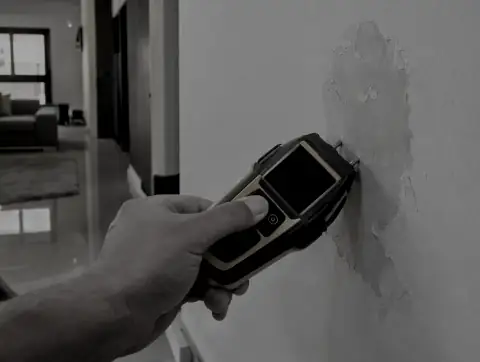
Damp & moisture detection and treatment in Government Departments
Damp treatment in the Government Departments area begins with photos of the damaged wall, ceiling or floor, sent to us by call or WhatsApp. The area mixes official buildings with residential blocks and villas, so damp can differ a great deal from one building to the next.
The area around the government departments combines larger office and public buildings with nearby houses and apartment blocks. Office buildings often have wide flat roofs, long external walls and bathrooms grouped on upper floors, so leaks can travel far from their source. In nearby residential blocks, damp usually starts in shared stairwells, car park walls or ground-floor flats. Because building types vary this much, we judge each case from its own photos rather than from the district name.
- Government Departments is a district in the Eastern Province, close to Yebrin and Ar Rabie.
- Leaks in a wide flat roof can travel a long way along the slab before they show as a stain.
The damp & moisture detection and treatment work in Government Departments
- Reinstating the render and finish after the surface has dried
- Treating cracks and applying the right barrier for the moisture source
- Covering work on walls, pools, tanks, bathrooms and roofs
- Identifying the type of damp: rising, penetrating, condensation or a pipe leak
From first contact to the finished job in Government Departments
Send photos on WhatsApp
Photos of the patches, the salts, the peeling paint and where the smell is strongest help us read the type of damp and decide what instruments and treatment are needed.
Measure and locate the moisture
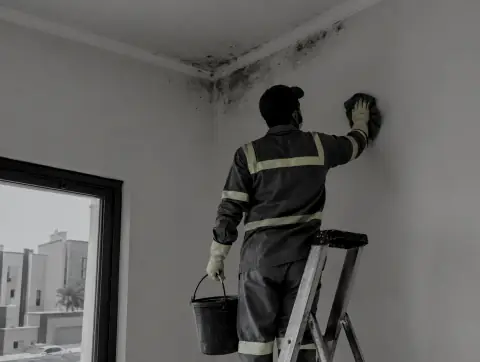
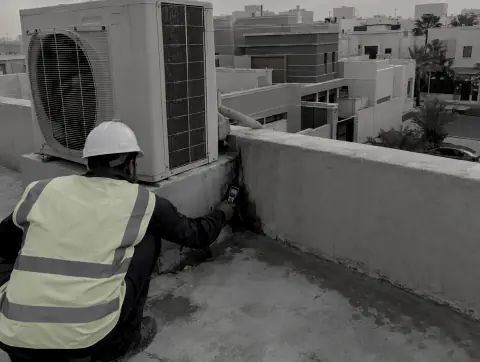
Moisture levels in the wall or ceiling are measured with instruments. The source is identified: rising damp, penetrating damp, condensation or a pipe leak. The treatment follows the source, not the surface sign.
Treat the real cause
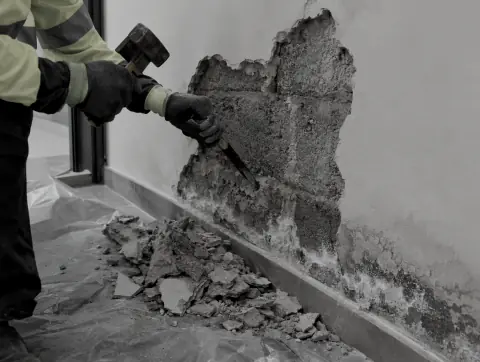
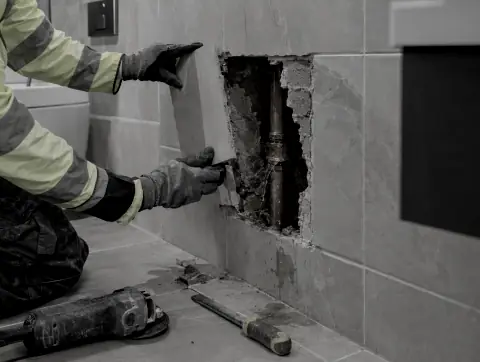
Depending on the source: damaged render is removed and cracks are treated, or the pipe fault is repaired, or the wall and ceiling are sealed. The render and paint are reinstated once the cause is gone.
Finish the surface after drying
The area is left to dry and set before the final render and paint, because coating a surface that is still damp only brings back the peeling.
Why Abraj Al Azl?
A protected surface after treatmentWhen the cause is treated, the surface is sealed with the right material and the render and paint are reinstated, less water vapour and external moisture reaches it.
Government Departments is in our service areaWe work there and across the Eastern Province, from our base in Al Uwaymiriyah, Hofuf.
Start from Government Departments with one messageSend us photos of the spot on WhatsApp and we will work out the next step with you.
Talk to us directlyCall or WhatsApp on the same number.
Some of our work

















What our customers said
ماشاء الله عملهم للعزل والتسريبات ممتاز وخبره ودقه في العمل انصح بالتعامل معهم
اتعاملت معاهم في العوازل عند كفيلي شغل يبيض الوجه انص التعامل معهم
ماشاء الله تبارك الرحمن عزل اسطح ممتاز
Real Google reviews, shown exactly as their authors wrote them.
Common questions on damp & moisture detection and treatment in Government Departments
Can a leak on an upper floor cause damp below in this area?
It can, because water may run along the slab or down a vertical shaft before it reaches a wall or ceiling lower down. Send photos of the upper floor, the ceiling below and any service shafts so we can follow the route.
Do you treat damp in shared car park walls and stairwells?
Yes, we serve the Government Departments area. Tell us which part of the building is affected, whether it is a shared stairwell, car park wall or a private flat, and send photos of the surface and the wall above it.
Is an anti-damp paint enough to fix the problem?
No. Anti-damp paint slows the visible signs but does not stop the source. If the damp is rising, penetrating or coming from a pipe, paint over it peels again quickly because water is pushing from behind. Correct treatment removes the damaged render, deals with the cause and puts a barrier of the right material in place.
Can damp be treated without removing the tiles or the render?
Sometimes a barrier material can be injected into the wall without removing all the render, or the surface can be treated from outside if the source is penetrating damp. But if the render is salt-damaged and crumbling, removing it is necessary because a sealing material cannot bond to a friable surface. Photos of the surface show whether removal is needed.
Is condensation treated the same way as rising damp?
No. Condensation is water vapour in the air that turns to drops on cold surfaces. Treating it means improving ventilation and insulating the surface to raise its temperature, not putting a barrier in the wall. Rising damp needs a barrier that stops water climbing from the ground. Confusing the two leads to the wrong treatment and the problem returns.
Do you cover Government Departments?
Yes. We serve Government Departments and nearby areas such as Yebrin (near Al Ekhaa), Yabrin (near Al Khunn) and Ar Rabie (near Al Khunn), from our base in Al Uwaymiriyah, Hofuf. Start with a call or a WhatsApp message.
The same service in nearby areas
We also offer damp & moisture detection and treatment in Yebrin (near Al Ekhaa), Yabrin (near Al Khunn) and Ar Rabie (near Al Khunn), among the closest areas to Government Departments.
More services in Government Departments